
The upcoming European Total Solar Eclipse on August 12, 2026, is set to be one of the most spectacular astronomical events of the decade. Millions of travelers will flock to the path of totality in Spain and Iceland, while viewers across the UK and the rest of Europe will witness a breathtaking partial eclipse.
But a solar eclipse is not a single, instantaneous moment. It is a dynamic, evolving process that unfolds over several hours, featuring dramatic visual and atmospheric changes.
Knowing exactly what happens during each stage ensures you will not miss any of the rare, fleeting phenomena. Rely on ORRO to keep your vision safe, and prepare yourself to witness the awe-inspiring stages of a total solar eclipse.
First Contact: The Partial Eclipse Begins
The eclipse officially kicks off during a phase known as "First Contact." This is the exact moment the moon's invisible shadow first touches the edge of the sun's brilliant disk.
At first glance, it will look as though a tiny, dark bite has been taken out of the sun. Over the next hour or so, the moon will slowly and steadily creep across the sun, obscuring more and more of its light.
During this entire partial phase, the sun's rays remain incredibly intense and dangerous to the naked eye. You must wear protective eyewear to observe this slow, mesmerizing progression.
Ensure your equipment is strictly EN ISO 12312-2:2015 tested. Unverified lenses can easily let in harmful ultraviolet and infrared radiation, causing permanent retinal damage without you even feeling it.
Second Contact: The Total Eclipse Begins
As the moon almost entirely covers the sun, the eclipse enters "Second Contact," where the most dramatic optical phenomena occur in rapid succession. The lighting around you will take on an eerie, silvery twilight quality.
If you look at the ground or the sides of buildings, you might notice rapid, wavy lines of alternating light and dark. These are known as shadow bands, caused by the Earth's turbulent atmosphere refracting the last slivers of sunlight.
Just seconds before totality, you will witness two of the most famous visual treats:
- Baily's Beads: Tiny, brilliant dots of sunlight shining through the deep valleys and craters along the moon's jagged horizon.
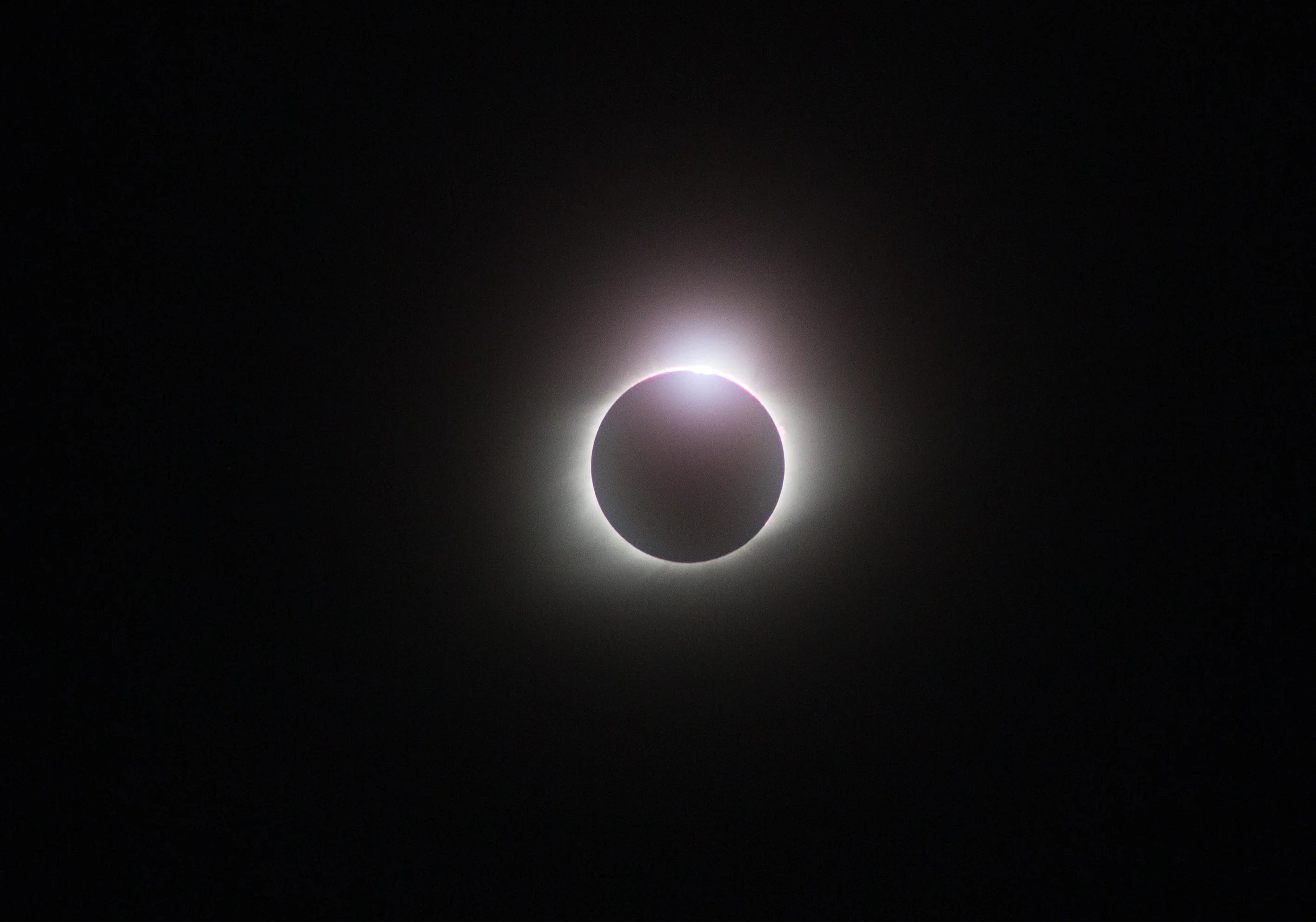
- The Diamond Ring Effect: As Baily's Beads fade, a single, dazzling spot of sunlight remains on the edge of the moon, looking exactly like a giant diamond ring in the sky.
Totality: The Maximum Eclipse
When the diamond ring fades, you have finally reached Totality, or "Maximum Eclipse." The moon now completely covers the bright face of the sun, casting a deep shadow over the Earth.
This is the only stage where you can briefly remove your solar glasses. When you look up, you will see the sun's corona, which is the outer solar atmosphere, appearing as ethereal streams of white light radiating into the dark sky.
The environmental changes during totality are profound. The ambient temperature can rapidly drop by 10 to 15 degrees Fahrenheit, and a sudden, unseasonal breeze known as the "eclipse wind" often kicks up.
Nature itself gets entirely confused by the sudden midday darkness. Birds will return to their nests, crickets will begin to chirp, and the entire landscape will fall into a hushed, surreal silence.
Third and Fourth Contact: The Sun Returns
Totality only lasts for a few minutes before the moon continues its orbit, leading to "Third Contact." The entire sequence of events from Second Contact will happen again, but in reverse.
The diamond ring effect will suddenly burst forth on the opposite side of the moon, followed quickly by the reappearance of Baily's Beads. At this exact moment, you must immediately put your protective eyewear back on.
The moon will then slowly reveal more of the sun's disk during the final partial phase. The eclipse finally concludes at "Fourth Contact," when the edge of the moon completely leaves the sun, returning the day to normal.
To pinpoint the exact timings of these stages for your specific viewing location, check out our highly detailed 2026 Eclipse Path Guide.
Why the Right Eyewear is Non-Negotiable
Aside from the brief minutes of totality, looking directly at the sun during the partial phases requires heavy-duty solar filtration. Safety is our absolute number one priority.
When you buy your premium ORRO Solar Eclipse Glasses, you are investing in superior construction. Our viewers feature thicker, multi-layered lenses that block 100% of dangerous UV and IR radiation, offering an optical clarity that cheap competitors cannot match.
Furthermore, our heavier paper frames are designed to withstand the rigors of travel and crowded viewing events. They will not easily tear, warp, or snap inside a hot backpack, ensuring your lenses remain perfectly intact when you need them.
Because every single pair is rigorously EN ISO 12312-2:2015 tested, you have absolute peace of mind. Your family can comfortably and safely enjoy the long partial phases leading up to the main event.
Equipping Groups for the Celestial Show
The sheer length of an eclipse makes it an incredible educational opportunity for schools, astronomy clubs, and travel agencies. Watching the slow progression from First Contact to Totality is a captivating experience for a group.
However, managing the eye safety of dozens of excited people requires reliable gear. If you are coordinating a large viewing party, do not trust your group's vision to flimsy, unverified market knock-offs.
Visit our Wholesale & Bulk Orders page to ensure your entire organization is fully equipped with heavily tested, premium eyewear well before the inevitable global supply shortages hit.
Protect Your Vision, Experience the Magic
Understanding the stages of the 2026 eclipse transforms the event from a simple observation into an immersive, step-by-step astronomical journey. From the first bite of the sun to the dazzling diamond ring, each phase offers its own unique magic.
Prepare yourself for the sudden temperature drops, watch the incredible shadow bands, and listen to the landscape fall completely silent. Just remember that safely witnessing these stages requires uncompromising eye protection.
Do not gamble with your eyesight or wait until the last minute when the world's supply of genuine stock is completely sold out. Protect your vision now so you can focus entirely on the awe-inspiring magic of the cosmos.