

If you have ever spoken to someone who has witnessed a total solar eclipse, you have likely heard them describe it as a life-changing experience. They talk about the sky turning dark in the middle of the day, the stars suddenly appearing, and the breathtaking silver halo shimmering where the sun used to be. But what exactly is happening during this astronomical phenomenon? The answer lies in a single, magical word: Totality.
As we approach the highly anticipated European total solar eclipse on August 12, 2026, understanding totality is the key to planning the perfect viewing experience. Whether you are an experienced "eclipse chaser" or a curious first-timer, this guide will explain everything you need to know about totality, the stages of an eclipse, and how to safely prepare for the event using EN ISO 12312-2:2015 tested solar eclipse glasses.
Understanding the Magic: What Exactly is Totality?
In astronomical terms, totality is the brief period during a total solar eclipse when the moon completely covers the bright disk of the sun.
This spectacular cosmic coincidence happens because of a unique geometric alignment. Even though the sun is about 400 times wider than the moon, it also happens to be about 400 times farther away from Earth. Because of this perfect ratio, the sun and the moon appear to be the exact same size in our sky.
When the Earth, moon, and sun align perfectly, an event known as syzygy, the moon casts a shadow onto the Earth. If you are standing in the darkest, central part of that shadow (the umbra), you will experience totality. If you are slightly outside of this specific path, you will only see a partial eclipse.
During totality, the sun’s blinding light is blocked, revealing the solar corona, the sun's outer atmosphere. This ghostly, wispy halo of superheated plasma is always there, but it is normally entirely hidden by the sun's intense glare. Totality is the only time human eyes can safely look at the solar corona without protective eyewear.

The Stages of a Total Solar Eclipse
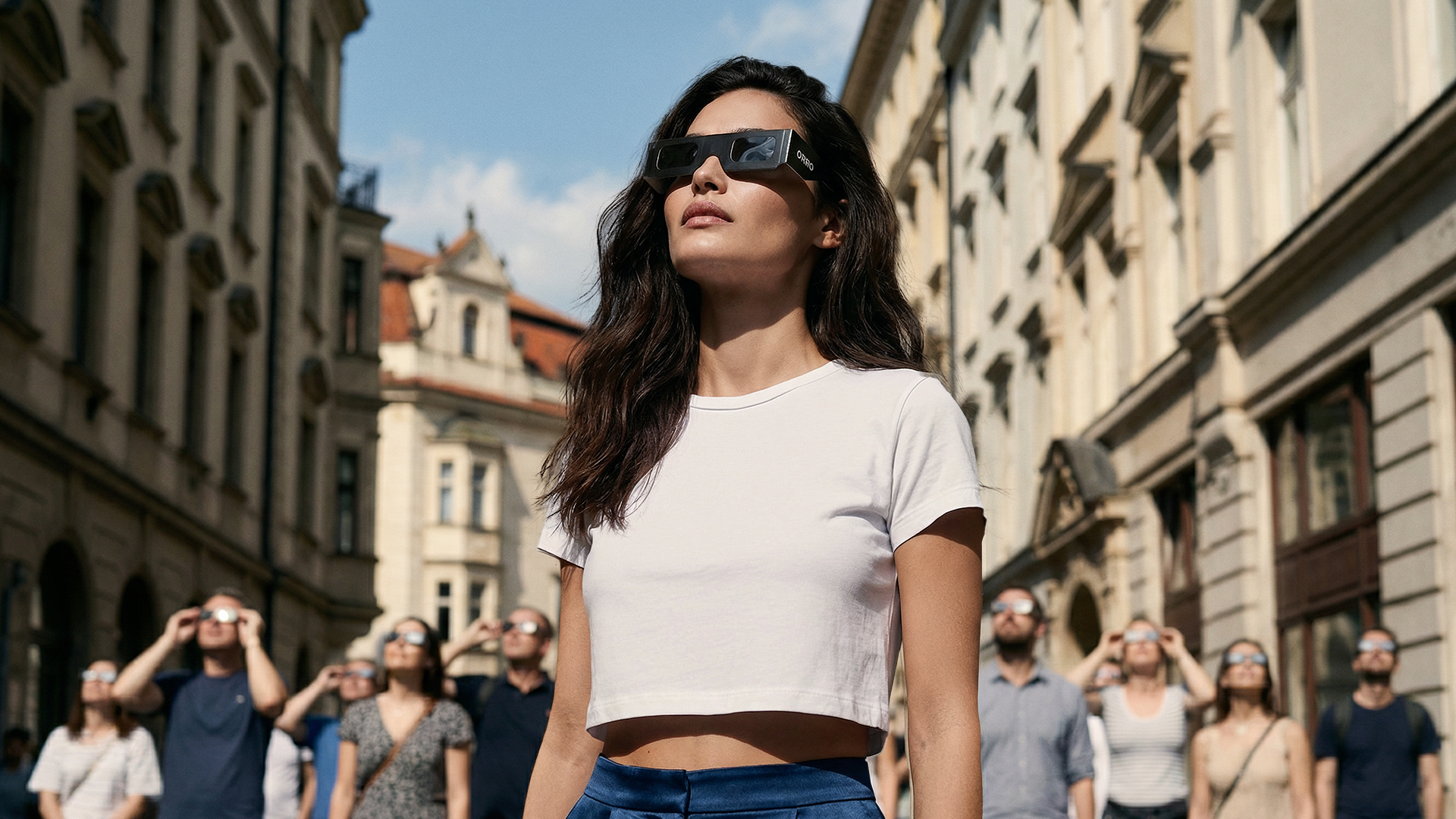
A total solar eclipse is not a momentary event; it is a multi-hour celestial performance. Understanding the phases will help you know exactly what to look for and when to wear your ORRO solar eclipse glasses.
First Contact: The Partial Phase Begins
The event kicks off when the moon takes its very first "bite" out of the sun. This is called First Contact. Over the next hour or more, the moon will slowly creep across the solar disk. During this entire phase, the sun is dangerously bright. You must wear your EN ISO 12312-2:2015 tested eclipse glasses to look at the sun. As the partial phase progresses, you might notice the daylight taking on a strange, silvery quality, and shadows on the ground may look unusually sharp.
Second Contact: Baily’s Beads and the Diamond Ring
Just moments before totality begins, the last rays of sunlight peek through the rugged valleys and craters on the edge of the moon. This creates a spectacular effect known as Baily's Beads, a string of glowing, bead-like spots of light.
Immediately following this, a single, brilliant bead of light remains, paired with the faint glow of the emerging corona. This is the famous Diamond Ring effect. Once the diamond ring fades, Second Contact is complete, and totality officially begins.
Totality: The Main Event
This is the moment you have been waiting for. The sky plunges into a deep twilight. The temperature drops noticeably, sometimes by as much as 10 to 15 degrees Fahrenheit. Animals may act strangely, birds might stop singing and return to their nests, believing night has fallen, while crickets begin to chirp.
Look around the horizon, and you will see a 360-degree sunset, a glowing band of orange and pink light marking the edge of the moon's shadow. Look up, and the solar corona is fully visible. This is the only time during the entire eclipse that it is safe to remove your solar eclipse glasses. Depending on your exact location, totality can last anywhere from a few fleeting seconds to several minutes. For the 2026 eclipse, viewers in the most optimal locations will enjoy over two minutes of totality.
Third and Fourth Contact: The Sun Returns
Totality ends just as abruptly as it began. As the moon continues its orbit, the first sliver of sunlight re-emerges from the opposite side. Another Diamond Ring flashes in the sky, marking Third Contact. You must immediately put your solar eclipse glasses back on the moment the bright sunlight reappears.
The moon will then slowly move away during the final partial phase until Fourth Contact, when the sun is completely unblocked, and the eclipse concludes.
Why the 2026 Solar Eclipse is a Must-See Event
While solar eclipses happen somewhere on Earth every 18 months or so, they often occur over open oceans or uninhabited areas. The upcoming total solar eclipse on August 12, 2026, is incredibly special because its path of totality sweeps directly over highly accessible and stunningly beautiful parts of Europe.
This will be the first total solar eclipse visible in mainland Europe since 1999. The path of totality will begin in the Arctic, sweep down over the western edge of Iceland (including near Reykjavik), cross the Atlantic Ocean, and carve a path straight through northern Spain before ending in the Mediterranean Sea near the Balearic Islands.
Because this event lines up with the peak European summer holiday season, millions of people are expected to travel to the path of totality. If you want to dive deeper into the exact locations and visibility tiers, check out our comprehensive 2026 Solar Eclipse Map and Path Guide.
How to Safely Watch a Solar Eclipse
Eye safety is the most critical aspect of eclipse chasing. Staring at the sun, even when it is 99% covered by the moon, can cause permanent retinal damage, a condition known as solar retinopathy.
Why EN ISO 12312-2:2015 Tested Glasses are Essential
Standard sunglasses, no matter how dark or expensive, are entirely useless for solar viewing. They transmit thousands of times too much sunlight. To view the partial phases of the eclipse safely, you need specialized solar filters.
At ORRO, our eclipse glasses are strictly manufactured to meet the EN ISO 12312-2:2015 international safety standard. Our premium, multi-layered optical lenses are designed to be thicker, stronger, and safer. They block out 100% of harmful ultraviolet (UV) rays, 100% of infrared (IR) rays, and 99.999% of intense visible light.
Remember the golden rule of eclipse viewing: Your glasses must be worn at all times when any part of the sun’s bright disk is visible. You can only remove them during the brief window of 100% totality. If you are viewing the eclipse from outside the path of totality (such as in the UK, France, or Germany), you will only experience a partial eclipse, meaning your glasses must stay on for the entire event.
Organizing a viewing party for your school, company, or community? Make sure everyone is protected by visiting our Wholesale & Bulk Orders page for discounted rates on certified eyewear.
Preparing for Your Eclipse Chasing Adventure
Seeing totality requires a bit of planning. Here are a few tips to ensure you have the best experience on August 12, 2026:
- Get to the Path: While a 90% partial eclipse is interesting, it is nothing compared to 100% totality. If you have the means, travel into the path of totality. The difference between 99% and 100% is literally the difference between day and night.
- Watch the Weather: Cloud cover is the enemy of the eclipse chaser. Northern Spain historically offers excellent clear-sky prospects in August, but always have a backup plan and stay mobile if possible. You can read more about planning your trip in our Eclipse Viewing Expedition Guide.
- Buy Your Gear Early: As the eclipse draws nearer, high-quality, ISO-certified glasses will sell out globally. Don't risk buying unverified, fake glasses from third-party marketplaces at the last minute. Secure your premium ORRO Solar Eclipse Glasses today to guarantee your eyes are protected.
Don't Miss the Shadow
Totality is a rare, humbling, and profoundly beautiful reminder of our place in the solar system. The sudden darkness, the chilling air, and the glowing corona create an atmosphere that photographs simply cannot capture.
As August 2026 approaches, make your travel plans, gather your friends and family, and most importantly, protect your vision. Shop our collection of ISO-tested Solar Eclipse Glasses today and get ready to witness the universe in action.